



What is the Pomodoro Technique? How to focus and get more done

Do you find yourself staring at your screen, unable to focus? Your to-do list grows longer by the hour, yet you complete very little. Distractions pull you in every direction, and procrastination becomes your constant companion.
We know how frustrating that feels. Many of us struggle with concentration, especially when facing large tasks or long workdays. We want to share a simple trick that changed everything for you. It is called the pomodoro technique.
A 2025 meta-analysis found that time-structured work intervals improved focus and reduced mental fatigue. This method transforms how you work.
 Keep updated, follow The Business Standard's Google news channel
So, grab a cup of coffee, and let's go through it together. We will show you exactly how to boost your productivity today.
What Is the Pomodoro Technique?
The pomodoro technique is a time management method developed by Francesco Cirillo in the late 1980s. He invented it in Italy while he was a university student. It started with a tomato-shaped kitchen timer that Cirillo used to track his study sessions.
The Italian word for tomato is pomodoro, which gave the method its famous name. In Italian, the plural is pomodori. This system uses a timer to break your work into intervals of exactly 25 minutes in length, separated by short breaks. Each interval is known as a pomodoro. After every single pomodoro, you must take a short 5-minute break.
This simple system helps you manage your time and reduces a major source of anxiety. It works because it directly fights modern office distractions. A 2026 report by Speakwise found that the average US worker faces 15 interruptions per hour.
To fix this, you do 25-minute work blocks, then pause to recharge. A single pomodoro is indivisible. If an interruption stops your focused work, that pomodoro must be abandoned, or you record the task for later.
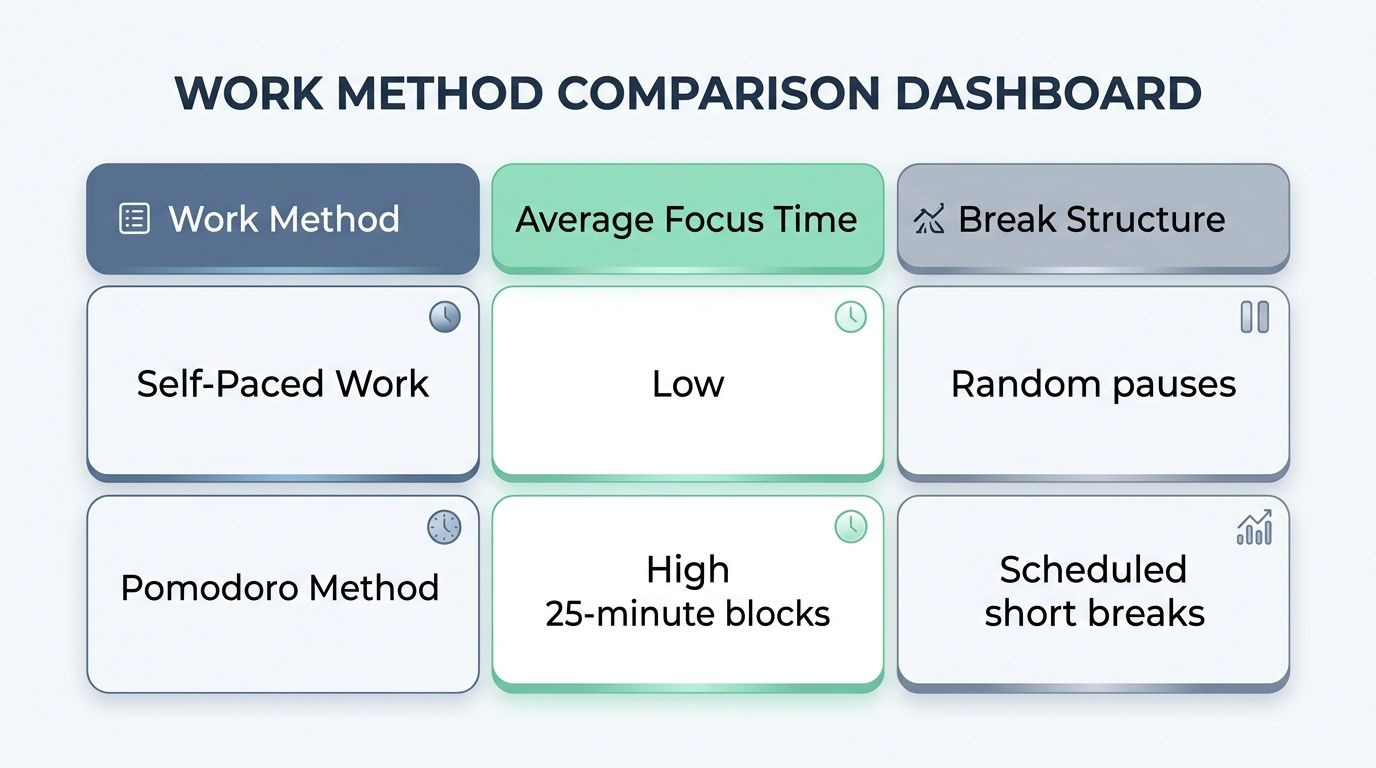
|
Work method |
Average focus time |
Break structure |
|
Self-Paced work |
Low (Easily interrupted) |
Random pauses, often leading to fatigue |
|
Pomodoro method |
High (25-minute blocks) |
Scheduled short breaks |
You can use a customizable pomodoro timer on your desk, a web browser extension, or a mechanical timer. The pomodoro technique is one of the most practical methods available today, and it costs nothing to start.
Steps to implement the Pomodoro Technique
You start by grabbing an egg timer and setting it for 25 minutes of work. Then you pick one task, silence your distractions, and work flat out until the timer rings.

Setting a timer for focused intervals
A timer transforms your work into manageable chunks. This tool keeps you locked in and stops distractions before they start.
- Grab a physical egg timer, or use a dedicated app like the Forest app. The Forest app gamifies your productivity by growing a virtual tree while you work.
- Wind up the mechanical timer yourself. The physical act of winding signals to your brain that work begins now.
- Set the timer for 25 minutes of work, which forms one pomodoro.
- Place your mobile phone in another room before you start working.
- Let the timer ring signal the end of your pomodoro time. Do not postpone your break when the timer goes off.
The pomodoro technique may feel strange at first, but it works. If 25 minutes feels too long, try shorter intervals of 10 to 15 minutes. The goal is to build your focus habit slowly. You do not need to read a long Wikipedia article to understand how to begin.
Taking short and long breaks
Breaks form the backbone of the pomodoro method. They stop your brain from burning out and keep your attention sharp for the next push. Longer focus periods require longer rests.
Research shows why these pauses matter for productivity. A 2026 Kimai report noted that it takes a staggering 23 minutes and 15 seconds to refocus after an interruption.
Scheduled breaks prevent those random interruptions from ruining your workflow.
Short breaks arrive after each work block. You take a five-minute break or a ten-minute break to grab a snack, stretch, or walk around. You simply work for 25 minutes and take a pause.
Once you complete four pomodoros, you earn a longer rest. You take a longer break of twenty to thirty minutes. This longer break lets your mind recover fully.
"Taking structured breaks stops mental fatigue from piling up during your workday."
Organisation matters when you use the pomodoro technique to work. You need to estimate how many pomodoros each task or project requires. Track your progress with a pencil and paper to stay on schedule.
Benefits of the Pomodoro Technique for productivity
Your focus sharpens when you work in short bursts. You finish more long tasks because you stop burning out.
Improved focus and reduced mental fatigue
Your brain gets tired when you work for too long without a rest. This time management method developed by Francesco Cirillo solves this exact issue through a steady rhythm.
You do blocks of deep work, then rest. This rhythm keeps your mind sharp and fights off fatigue. The psychology behind this is incredibly simple and effective.
Mental tiredness ruins productivity faster than almost anything else. A 2025 Clockify study revealed that distractions cost US businesses roughly 650 billion dollars every single year.
The technique helps you stay focused because it matches how your brain functions. After completing four pomodoros for tasks, you take a longer rest period.
Here is why this rhythm reduces mental fatigue:
- It creates a predictable structure for your workday.
- It prevents the exhaustion of overlearning whether you need to study for an exam or write a report.
- It provides a built-in reward system for your brain.
These short breaks help you absorb knowledge and make learning much easier.
Better time management and task completion
The technique helps you completely transform how you handle your daily to-do list. You start by writing down all your long tasks and estimating the effort required.
Once you have your list, you tackle one task at a time. The tomato timer becomes your guide. Every pomodoro represents a block of pure dedication.

The 2025 Clockify report also showed that 60 percent of people using the pomodoro technique successfully manage their tasks four to five days a week. That is a massive boost to consistency.
Tracking your work sessions helps you see real progress. Many professionals use specific digital tools to pair with this method:
- Toggl Track connects your focused intervals directly to your timesheets.
- Pomofocus provides a simple web browser timer with daily reports.
- Focus Keeper tracks your daily cycles and switches between work and rest automatically.
You easily learn to use the remaining time in each interval wisely. You might use those final minutes to review the list and update your plans.
Final words
You now hold the key to working smarter, not harder. This simple method transforms your workday into manageable chunks. Focus will start to feel natural rather than forced.
Your brain gets the breaks it needs, and your tasks get the attention they deserve. Your productivity will soar as a result.
Start with just one pomodoro today. Grab a kitchen timer, and watch how this system reshapes what you can accomplish. You really have got this!
Frequently asked questions (FAQs)
1. What is the Pomodoro Technique and where did it come from?
The Pomodoro Technique is a time management method created by Francesco Cirillo in Italy during the late 1980s. He named it after the tomato-shaped kitchen timer he grabbed whilst studying at university.
2. How does the Pomodoro Technique work for learning or studying?
You set a timer for 25-minute focused intervals called pomodoros, work on just one task, then take a 5-minute break. After you've done four pomodoros, you earn a longer break of 15 to 30 minutes.
3. Why do people say the Pomodoro Technique helps with focus and getting more done?
Those 25-minute bursts actually match our brain's natural attention span, so you avoid mental fatigue whilst the regular breaks help you stay fresh and focused.
4. Can I use any kind of timer for this time management method?
Absolutely, any timer will do, whether it's a basic kitchen timer or an app like Focus Keeper, as long as you commit to the full session.
5. Is there science or psychology behind why this technique works well?
Yes, it's based on timeboxing, a psychology principle that shows how setting fixed time limits creates healthy urgency and reduces procrastination


