Farakka now boomerangs on India
Since 1975, water extraction from the Farakka upstream has led to a drop in groundwater as well as surface water levels in the vast Barind Tract region along the River Padma and its tributaries in Bangladesh
The Farakka barrage – certainly a bane for Bangladeshis for the past five decades – has now become a major cause of concern for India as well.
The barrage has been blamed for the recent flooding in the states of Bihar and Uttar Pradesh and parts of West Bengal in India. It has also been responsible for river erosion, and a destruction of the aquatic ecosystem, as a result of which Hilsha fish are no longer to be found in Indian rivers.
It may be recalled that the late veteran politician Maulana Abdul Hamid Khan Bhashani turned into an iconic environmentalist when he led thousands of Bangladeshis in a massive long march on May 16, 1976 to protest the operation of the controversial Farakka barrage that had been commissioned the previous year.
 Keep updated, follow The Business Standard's Google news channel
The Maulana and his followers were protesting the impediment of the natural flow of the transboundary Ganges River water by the construction of the barrage. At the same time, they were concerned about the harmful impacts on the river ecosystem downstream and so flowing into Bangladesh.
Prior to the Bhashani-led long march, Kapil Bhattacharya, at the time chief engineer of the West Bengal government, had protested the move once the Indian government began to build the 2.62km-long barrage 10km upstream from the Bangladesh-India border.
The barrage was constructed with the main objective of flushing out sediment deposits from Kolkata Port, besides addressing drinking water requirements in West Bengal.
In 1961, Kapil Bhattacharya, in a report titled "Silting of Calcutta Port", wrote that the barrage was being built without taking into consideration the flood tides and tide borne silts it would cause.
"As a result, the Calcutta Port has been killed and the main drainage channel choked, causing repeated flood-havoc on an ever-increasing scale," he added. "If my warnings against Farakka Barrage are not heeded, people will have to suffer consequences."
Kapil's premonitions turning out true
The chief engineer predicted that the barrage would only increase siltation in the river since in the dry season only half as much water would be available in the dam to divert towards Hooghly, leading to increased siltation. The barrage would also reduce water flow to Bangladesh.
He also made it clear that the dam was designed to discharge too little water in times of floods, which would in consequence lead to devastating floods upstream in Malda and Murshidabad in West Bengal and in several districts of Bihar through which the River Ganges flows.
Kapil's warnings led to him being labelled as a Pakistani spy at that time. Notwithstanding the condemnation he was subjected to over his report, all of his three predictions were eventually to come true, as an Indian news media outlet reported in 2016. In that year, Bihar faced devastating floods, prompting its Chief Minister Nitish Kumar to demand demolition of the Farakka barrage.
"This situation is the result of silt getting deposited in the Ganga after the construction of Farakka dam. The only way to remove silt from the river is to remove the dam," the Indian Express quoted the chief minister as saying.
For the last couple of years, Nitish Kumar has been trying to persuade the central government to ensure a maximum discharge of Ganges water downstream through Farakka barrage during the monsoon in order to save riverine areas of Bihar from impending threats of major floods.
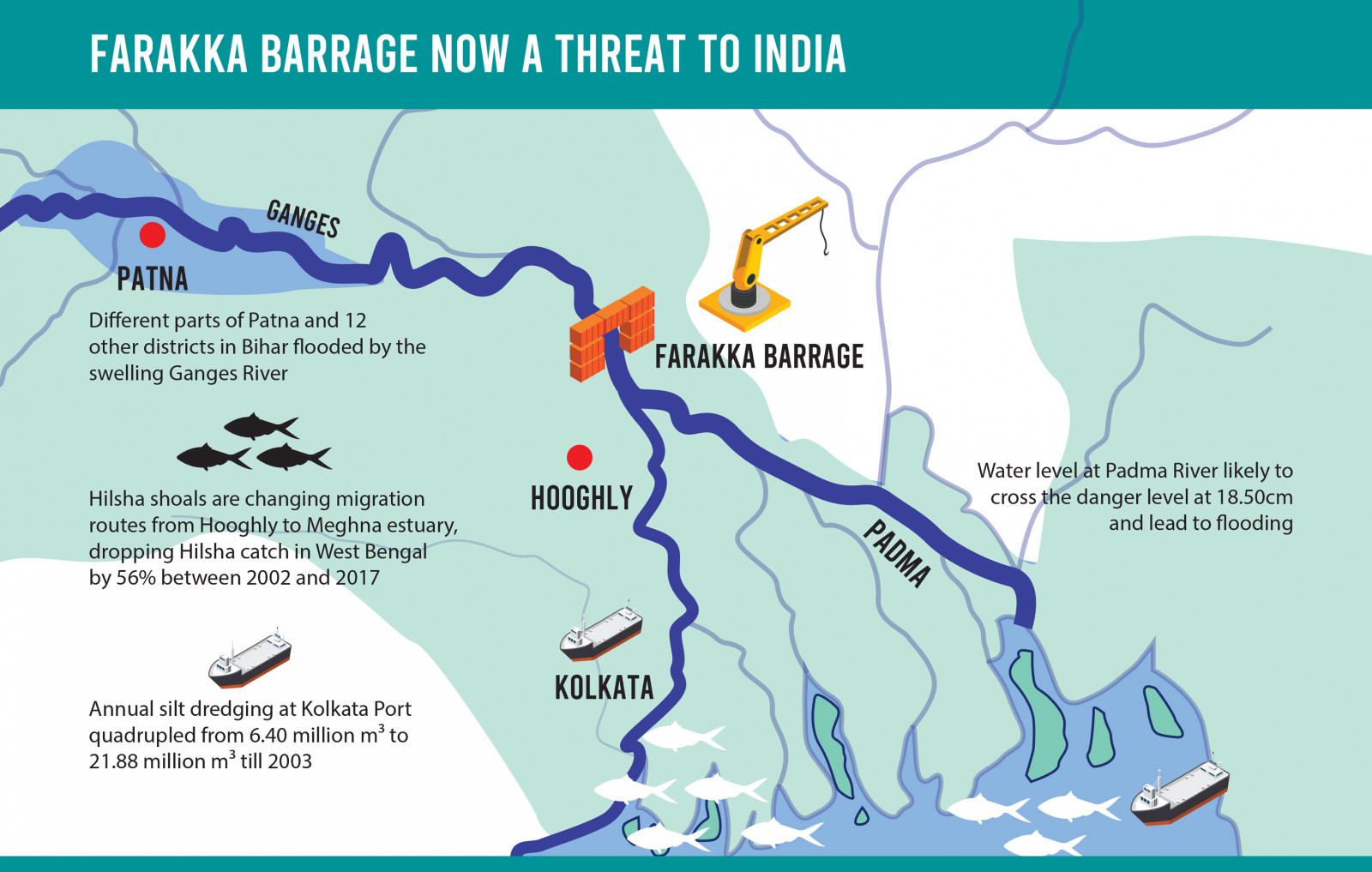
With a swelling Ganges flooding different parts of Patna and 12 other districts this monsoon, Nitish Kumar and his water resources minister Sanjay Kumar Jha have called upon the relevant authorities to ensure a regular discharge of at least 18 lakh cusecs (cubic metres per second) of water through the Farakka barrage till the entire spillover of floodwaters in Bihar are drained out, The Times of India reported last week.
The news outlet reported on September 30 that following repeated requests by Bihar state lawmakers, India's central government has directed that all 119 gates of the Farakka barrage be kept open.
The move in turn has led to an increase in the water level of the River Padma, the Ganges tributary in lower riparian Bangladesh. The Rajshahi office of the Bangladesh Water Development Board has reported that the water level is likely to cross the danger level at 18.50cm in the next couple of days, which holds the danger of conditions turning into flooding, according to the UNB.
However, a press release of Bangladesh Water Development Board issued on September 30 said the gates of the Farakka barrage remain open between July and October and it is therefore normal practice in the management of the barrage.
KM Anwar Hossain, the Bangladesh representative on the Joint Rivers Commission, told The Business Standard that Bangladesh cannot check the monsoon-time discharge of Ganges water from the Farakka barrage since the 1996 treaty on the sharing of the waters of the river at Farakka specifically deals with dry season water-sharing.
"Water route conversion through the barrage may give advantages to one Indian state, but at the same time it has emerged as a source of trouble to other Indian states," Anwar said, citing floods in Bihar and Uttar Pradesh.
Farakka hampers natural river flow in Bangladesh
Under the terms of the 1996 treaty on the sharing of the Ganges waters at Farakka, Bangladesh will receive 35,000 cusecs of water from Farakka over a series of 10-day periods from March 11 to May 10 every year.
An independent study titled "A critical review of the Ganges Water Sharing arrangement" by Water Policy of the World Water Council, published this year, notes, "A statistical analysis of the post-treaty data (1997–2016) indicates that in 65 percent of the time Bangladesh did not receive its guaranteed share during the critical dry periods with high water demand."
Since 1975, water extraction from the Farakka upstream has led to a drop in groundwater as well as surface water levels in the vast Barind Tract region along the River Padma and its tributaries in Bangladesh. Boro paddy cultivation as well as the ecosystem of the Sundarbans, the world's largest mangrove forest, has as a result been severely affected.
During the dry season, the River Passur, one of the tributaries of the River Padma and the lifeline of the Sundarbans, goes dry, causing saline water intrusion upstream of the Passur.
Is Farakka barrage a curse?
According to recent news reports by Indian agencies, only release of 2.75 lakh cusecs of water from Indrapuri barrage on the River Sone has worsened the situation in the River Ganges, forcing the central government to ensure a discharge of 18 lakh cusecs of water downstream through Farakka.
Meanwhile, available evidence suggests that the 2016 floods in Bihar were caused by a sudden release of water from the Bansagar dam across the River Sone in eastern Madhya Pradesh.
Bihar Chief Minister Nitish Kumar could thus be right in demanding the removal of the barrage for the de-siltation it causes upstream.
A year after the Bihar floods of 2016, the state government reported to a committee formed by the central government that the barrage was the genesis of severe flood consequences and responsible for a progressive silt increase in the Ganges upstream between Patna and Bhagalpur.
The state government referred to the data of Kolkata Port Trust, which noted that silt dredging at the port had increased from 6.40 million cubic metres annually from pre-Farakka days to four times during 2003.
"So the barrage is of no help…functioning of the barrage is itself giving rise to consequences of flooding," the state said in its submission.
Among others, the state blamed the barrage also for constricting the habitat and normal cycle of aquatic species, mainly fishes such as Hilsha.
It is worthwhile recalling that Magsaysay award winner Rajendra Singh, also known as Waterman, has labelled the Farakka barrage inauspicious for Bihar, describing it as a curse which needed to be removed.
M Inamul Haque, former director general of the Water Resources Planning Organisation under Bangladesh's water resources ministry, told The Business Standard, "Besides increasing siltation upstream, the Farakka barrage causes severe erosion across the River Bhagirathi in northeastern West Bengal.
"The barrage is not only affecting Bangladesh but also changing the river eco-system in India."
On September 23, the Times of India reported that shoals of Hilsha have been changing their migration routes from the Hooghly estuary to the Meghna in Bangladesh due to high siltation of the riverbed.
The newspaper also noted that in the decade and a half since 2002, Hilsha catch in West Bengal declined to 27,539 tonnes, a steep drop of 56 percent.
"During the period, Hilsha catch in Bangladesh has increased to 160 percent," Anisur Rahman, chief scientific officer at the Bangladesh Fisheries Research Institute, told The Business Standard.
Hilsha shoals need at least a depth of 15 feet in the water to run into the river, Anisur Rahman said, adding that fishes' migration routes change owing to siltation.
Utpal Bhaumik, a retired divisional head of the Central Inland Fisheries Research Institute of India, told the Times of India that the Hooghly estuary mouth is fast losing depth, mainly because of the Farakka barrage and a lack of proper dredging.
The Indian newspaper reports that India has to import Hilsha fish to meet its demand during Durga Puja celebrations.
As part of a goodwill gesture, the Bangladesh government has approved the export of 500 tonnes of Hilsha to India on the occasion of Durga Puja this month.