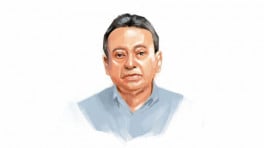
Bangladesh's external debt till February stands at $78.06b: Khosru
The finance minister also noted that since the current government assumed office, it has repaid loans amounting to approximately $90.66 million.

Highlights
- External debt stands at $78.06b as of February
- Govt has repaid $90.66m in foreign loans since taking office
- External debt previously peaked at $113.51b in Oct–Dec 2025
- Rise driven by increased borrowing and ACU-related inflows, offshore banking funds
- Bangladesh to pay $26b in external debt servicing by FY30
Bangladesh's total outstanding external debt stood at a little over $78.06 billion as of February, Finance Minister Amir Khosru Mahmud Chowdhury has said.
He disclosed the figure during a question-and-answer session in parliament today (21 April), responding to a query from Brahmanbaria-2 MP Rumeen Farhana.
 Keep updated, follow The Business Standard's Google news channel
Khosru said the Economic Relations Division (ERD) is responsible for servicing foreign loans on behalf of the government. "Each fiscal year, projections are made for principal and interest payments, and necessary allocations are included in the national budget to meet those obligations."
He added that debt repayments are carried out regularly in line with the scheduled payment plan using the allocated budget.
Khosru also noted that since the current government assumed office, it has repaid loans amounting to approximately $90.66 million.
Rising trend in recent quarters
Data from the Bangladesh Bank shows that external debt has been on an upward trend in recent quarters.
It stood at $113.51 billion in the October-December quarter of 2025, slightly higher than over $112 billion recorded in the July-September quarter, and $113.58 billion in the June quarter.
Central bank officials said the increase was driven by higher foreign borrowing in both public and private sectors. Of the total, public sector debt stood at $93.46 billion, while the private sector accounted for $20.05 billion.

A senior official noted that part of the rise in the December quarter was due to inflows into Asian Clearing Union (ACU)-related accounts and offshore banking units, as some payments were deferred to subsequent periods.
Around $400 million in foreign funds also entered offshore banking channels, contributing to the increase.
Concerns over utilisation and repayment pressure
Economists have stressed the importance of proper utilisation of foreign loans.
Zahid Hussain, former lead economist of the World Bank's Dhaka office, said foreign borrowing is necessary for development, but its effectiveness depends on how the funds are used.
"If the funds are invested in projects that improve people's lives and generate returns, it is justified. Otherwise, it becomes a burden," he said.
Bangladesh Bank officials also warned that proper use of external loans would strengthen repayment capacity, while misuse could increase pressure on the economy, urging stronger monitoring of fund utilisation.
According to an ERD report, Bangladesh is entering a period of heightened fiscal pressure, with external debt servicing expected to rise sharply over the next five years.
The country is projected to pay nearly $26 billion in external debt servicing between the current fiscal year and FY2030.
The scale of the burden is significant in the historical context. In the 54 years since independence in 1971, Bangladesh has paid around $40 billion in debt servicing – meaning nearly two-thirds of that amount will be repaid within just five years.
This comes as the tax-to-GDP ratio has fallen below 7%, one of the lowest among comparable economies, limiting the government's ability to manage fiscal shocks or expand spending.
Ongoing global and domestic challenges – including the Covid-19 pandemic, the Ukraine war, political instability and tensions in the Middle East – have further strained revenue, exports and remittance inflows, adding to the pressure on debt servicing.