



What four local airlines plan for int'l expansion this year amid global aviation bottlenecks
From the historic streets of Rome to the bustling hubs of Southeast Asia, the goal is clear: to reclaim a market driven by a surge in outbound migrant labour and a growing appetite for regional leisure travel

Bangladesh's aviation sector is on the very verge of a significant shift. Despite a global aircraft crunch and a market where 37 foreign carriers currently control over 70% of international traffic, four local airlines are gearing up for an aggressive push into global skies this year.
From the historic streets of Rome to the bustling hubs of Southeast Asia, the goal is clear: to reclaim a market driven by a surge in outbound migrant labour and a growing appetite for regional leisure travel.

At Hazrat Shahjalal International Airport (HSIA), international passenger numbers hit 12.5 million in 2024 (a 7% year-on-year increase), signalling a demand that local carriers are desperate to tap into.
 Keep updated, follow The Business Standard's Google news channel
US-Bangla: Destination Europe
The country's largest private carrier, US-Bangla Airlines, is leading the charge with a long-awaited entry into the European market. Having expanded its fleet to 25 aircraft, the airline is now navigating the rigorous international standards required for long-haul operations.
"We have been working extensively to start operations on the London and Rome routes," said Kamrul Islam, spokesperson for US-Bangla. While European skies are the primary goal for 2026, the airline is also targeting Madinah in the Middle East.
However, the carrier faces a double-edged sword. While it eyes expansion, it is struggling to maintain frequencies on regional routes like Chennai and Kolkata due to aircraft capacity constraints and shifting visa regimes.
NovoAir with its 6 new int'l routes
NovoAir has faced a frustrating three-year wait to secure lease-ready aircraft due to a global shortage.
A delegation is set to travel to Dublin — a global hub for aircraft leasing — later this month to finalise deals for Airbus A320 or A321 jets.
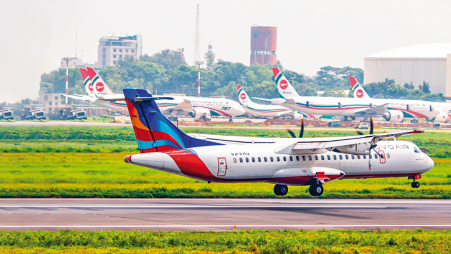
If successful, NovoAir plans a mid-year launch of a six-route network covering Bangkok, Kuala Lumpur, and Singapore in Southeast Asia, alongside Dubai, Sharjah, and Muscat in the Middle East.
NovoAir Managing Director Mofizur Rahman said, "If we can secure aircraft there [Dublin], we hope to launch our international network by mid-year."
Air Astra: The regional challenger
Air Astra is eyeing the first half of 2026 for its international debut. The airline has already secured frequency allocations for 12 international routes, with Nepal, Kuala Lumpur, Bangkok, and Singapore identified as its primary targets once new leased aircraft arrive.
"We expect to receive new aircraft through leasing by the first half of 2026," said Sakib Hasan Shuvo, the airline's deputy manager of public relations.
"After that, we plan to launch international routes, with Nepal, Kuala Lumpur, Bangkok and Singapore as our primary targets."
Biman: Caught in the 'leasing trap'
National flag carrier Biman Bangladesh Airlines, which currently operates 22 international routes, finds its growth hampered by the same supply chain disruptions affecting the private sector.
The Russia-Ukraine war and production delays at Boeing have created a worldwide shortage of narrow-body jets.

While Biman's board has approved the purchase of 14 new Boeing aircraft, the first delivery is at least four to five years away.
To bridge this "connectivity gap", Biman is directly negotiating with global lessors. Biman spokesperson Boshra Islam emphasised that expansion into East Asia and the United States depends entirely on the success of these interim leasing negotiations.
Why expansion is delayed
The primary hurdle for all four carriers is a "manufacturing bottleneck".
A post-pandemic surge in travel coincided with delivery delays, particularly involving the Boeing 737 MAX, making it nearly impossible to scale up immediately.
Furthermore, while domestic travel has softened due to improved road and rail infrastructure — such as the Padma Bridge — the international sector remains the "gold mine".
Between 2021 and 2025, approximately 50 lakh Bangladeshis migrated for work, creating a permanent and massive demand for affordable, direct flights to the Middle East and Southeast Asia.


