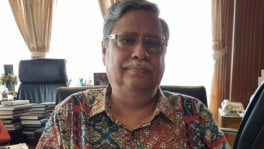
'We counted days by food': Hummam Quader recounts enforced disappearance before tribunal
He also said there was a lot written on the walls inside the room, which he understood had been written by previous detainees

While he was kept at Aynaghar, he could not tell the difference between day and night. He counted days by the food he was given. When bread was brought, he knew a new day had begun. Lunch and dinner consisted of rice, a piece of fish or a piece of chicken, along with some vegetables. One day, when biryani was served, he realised it was Eid.
Hummam Quader Chowdhury, son of the late BNP leader Salahuddin Quader Chowdhury, described these experiences of detention and torture at the Joint Interrogation Centre (JIC) cell – known as Aynaghar – during the Awami League regime, while testifying before the International Crimes Tribunal.
Hummam gave testimony today (19 January) before the three-member International Crimes Tribunal-1, led by Justice Md Golam Mortuza Majumder, in a case accusing ousted prime minister Sheikh Hasina and 12 others of crimes against humanity over enforced disappearance and torture at the Joint Interrogation Centre. He appeared as the first witness in the case.
 Keep updated, follow The Business Standard's Google news channel
In his testimony, Hummam said he was forcibly disappeared on 4 August 2016. During his disappearance, he could not distinguish between day and night and relied on food to mark the passage of time. When bread was brought for a meal, he understood a new day had started. Lunch and dinner usually consisted of rice, one piece of fish or chicken, and some vegetables. When biryani was served one day, he realised it was Eid.
"For the first two months, I kept track of days by making marks on the wall with a nail. After two months, I stopped counting," he said, adding he had found the nail in the corner of a window.
He also said there was a lot written on the walls inside the room, which he understood had been written by previous detainees. One message read: "No one will tell you how long you will be kept here."
On another wall, Hummam said, there was a drawing of the national flag of Bangladesh. He described the room as being 15 to 18 feet long and 8 to 10 feet wide. In one corner of the wall, he scratched his initials (HQC) and the date of his disappearance with the nail.
"During my disappearance, I was occasionally beaten during interrogations. I was questioned about my father's politics – whether I opposed the Awami League and whether I had links with any foreign intelligence agencies. These questions were repeatedly asked," Hummam said.
There are 13 accused in the case, 12 of whom are current or former military officers.
Three of the accused are currently under arrest: former directors of the Directorate General of Forces Intelligence (DGFI) – Major General Sheikh Md Sarwar Hossain, Brigadier General Md Mahbubur Rahman Siddiqui, and Brigadier General Ahmed Tanvir Mazahar Siddiqui. They were produced before the tribunal on Monday.
The remaining 10 accused are absconding. Among them are five former DGFI directors general: retired lieutenant general Md Akbar Hossain, retired major general Md Saiful Abedin, retired lieutenant general Md Saiful Alam, retired lieutenant general Ahmed Tabrez Shams Chowdhury, and retired major general Hamidul Haque.
Other absconding accused include former DGFI director retired major general Mohammad Touhidul Ul Islam, Major General Kabir Ahammed, and retired lieutenant colonel Mokhchurul Haque.
Additionally, ousted prime minister Sheikh Hasina and her defence affairs adviser, retired major general Tarique Ahmed Siddique, are also accused in the case.