Press Freedom Index: Bangladesh slips 3 notches to 152nd
The media environment remains fraught with structural challenges, including the lingering effects of the Cyber Security Act (CSA) -- a piece of legislation RSF describes as a "draconian tool" that allows for "warrantless arrests"

Bangladesh has dropped three places in the 2026 World Press Freedom Index, ranking 152nd out of 180 countries, according to the latest report by the international watchdog Reporters Sans Frontières (RSF).
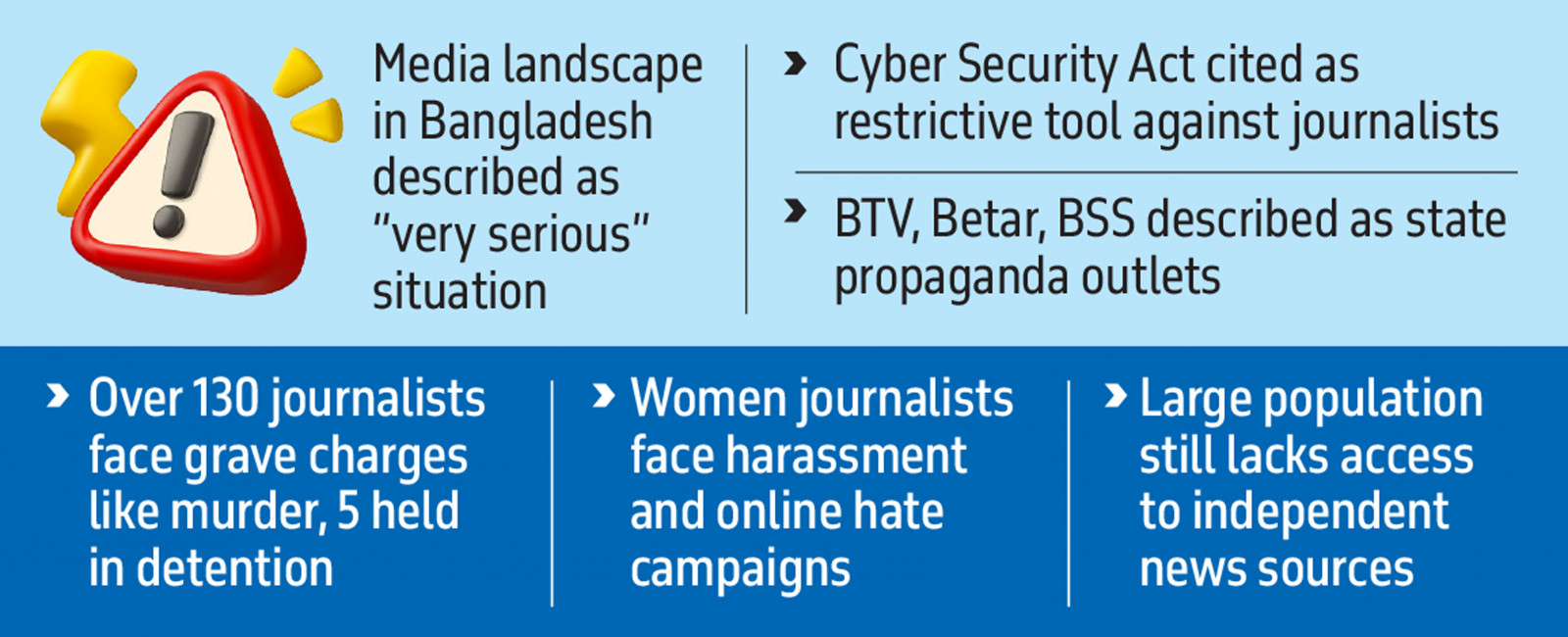
The decline comes at a time when global press freedom has hit its lowest point in 25 years, with the local landscape described as "very serious".
The RSF report highlighted that while the interim government led by Nobel laureate Muhammad Yunus served until February this year, the subsequent parliamentary elections brought the Bangladesh Nationalist Party (BNP) to power.
 Keep updated, follow The Business Standard's Google news channel
See the live tracker here: Reporters Without Borders
Despite the political transition, the media environment remains fraught with structural challenges, including the lingering effects of the Cyber Security Act (CSA) -- a piece of legislation RSF describes as a "draconian tool" that allows for "warrantless arrests" and the "violation of source confidentiality".
According to the watchdog, the state-owned broadcasters, Bangladesh Television (BTV) and Bangladesh Betar, alongside the news agency Bangladesh Sangbad Sangstha (BSS), continue to function as government propaganda outlets lacking editorial independence.\

While the private sector boasts 3,000 print outlets and 30 TV channels, major broadcasters like Jamuna TV, Somoy TV, and Ekattor TV -- which previously supported the Sheikh Hasina regime -- now refrain from criticising the current administration.
RSF noted that only a few outlets, including the Bengali daily Prothom Alo and the English-language The Daily Star, manage to maintain a degree of editorial independence.
The report also shed light on the "political purge" following the fall of the Sheikh Hasina government on 5 August 2024.
Over 130 journalists have been subjected to unfounded judicial proceedings, facing grave charges such as "murder" and "crimes against humanity," with at least five journalists currently detained.
RSF pointed out that the culture of impunity for violence against journalists, which was rampant during the 2009–2024 period, remains a significant concern.

The report stated that journalism in Bangladesh remains a male-dominated profession where women journalists face a deeply rooted culture of harassment and targeted online hate campaigns.
With over 20% of the 169 million population living below the poverty line, RSF noted that while the internet is becoming a vital source of information, a large segment of the populace still lacks access to reliable, independent news.