



No feasibility study, years of delays hobble Tk881cr Dhaka upgrade project
According to an Implementation Monitoring and Evaluation Division (IMED) review, the project was approved without the mandatory feasibility study
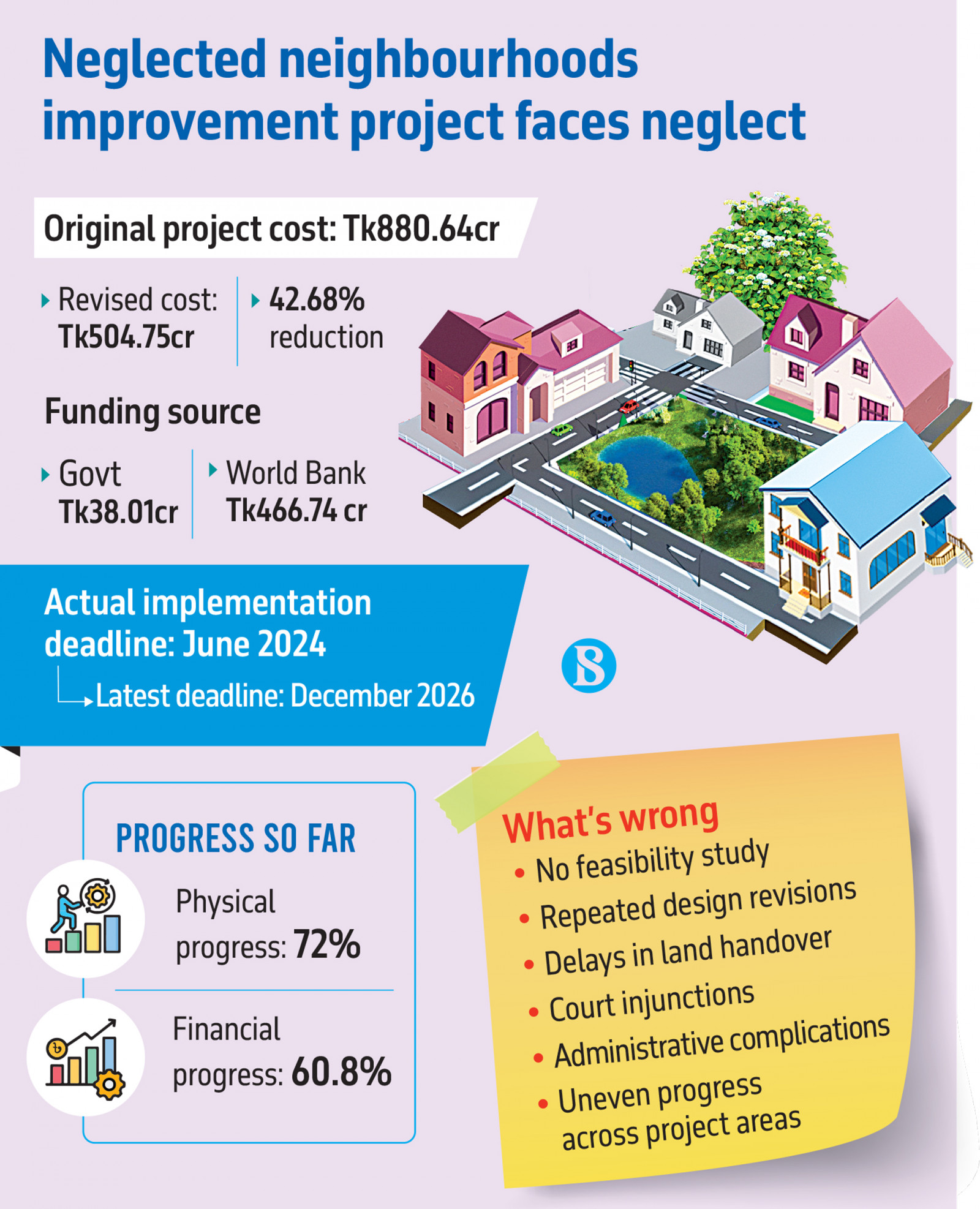
A Tk880.64 crore project launched in 2019 to improve living conditions in some of Dhaka's most neglected and densely populated neighbourhoods has yet to be completed.
According to an Implementation Monitoring and Evaluation Division (IMED) review, the project was approved without the mandatory feasibility study, while repeated design revisions, delays in land handover, court injunctions, administrative complications and uneven progress across project areas have prevented its completion despite two deadline extensions.
The Dhaka City Neighbourhood Upgrading Project was designed to improve roads, drains, footpaths, parks, playgrounds and community centres in Kamrangirchar, Lalbagh, Sutrapur-Nawabganj-Gulistan, and Khilgaon-Mugda-Basabo to enhance urban services and environmental conditions.
According to IMED's evaluation, one of the project's biggest weaknesses was the absence of the mandatory feasibility study required for projects costing more than Tk50 crore. The report recommends that future projects of this nature should be preceded by comprehensive feasibility studies, including land surveys, soil testing and hydrological assessments.
 Keep updated, follow The Business Standard's Google news channel
The project was scheduled between March 2019 and June 2024. As the work could not be completed on time, the deadline was extended twice until December 2026. At the same time, the project cost was reduced by Tk375.88 crore to Tk504.75 crore, comprising Tk38.01 crore in government funding and Tk466.74 crore from the World Bank.
Although the project's estimated cost has fallen by 42.68%, its implementation period has increased by nearly 47%. While some visible progress has been made in road construction, drainage and playground development, shortcomings in the original planning, repeated design changes, unequal progress across project areas and weak project management continue to undermine its objectives.
As of May this year, physical progress stood at 72%, while financial progress reached 60.8%. Work is ongoing on nine new community centres, road and drainage rehabilitation, footpath and playground improvements, pond restoration and the construction of waste transfer stations. However, IMED noted that financial progress remains particularly low in several components, including street lighting (5.89%), traffic signs (7.93%) and tree plantation (around 2%).
The report identified delays in site handover as the single biggest obstacle to implementation. It took eight months to demolish old structures through auction and hand over sites to contractors for constructing new community centres. At the Naolagola Community Centre, disputes over land forced planners to leave the building's ground floor open for public access. IMED observed that such practical challenges could have been identified earlier had proper technical studies been conducted before the project was approved.
IMED's field inspections also uncovered several design flaws. Although space was allocated for a library and fish market on the third floor of the Naolagola Community Centre, no toilet facilities were included. Contractors also reported that the construction package for the Metropolitan Theatre did not include electrical works, ceilings, air-conditioning or sound systems, despite ongoing structural work.
In addition, while the original plan called for solar-powered street lighting, conventional electric LED lights were installed instead. The report also found that tree species were selected without consulting the Forest Department, contrary to project guidelines.
The project has faced 25 audit objections over six of its nine financial years, with most still unresolved. The amount involved totals Tk16.3 crore. IMED also identified several management weaknesses. Only seven of the planned 18 Project Implementation Committee (PIC) meetings and four of the scheduled 18 Project Steering Committee (PSC) meetings were held, representing 38.89% and 22.22% of the targets respectively.
Seven of the project's 28 approved posts remain vacant, including key technical positions such as executive engineer and assistant engineer.
Urban planner Professor Dr Adil Muhammad Khan told TBS that the fundamental problem was approving such a large project without a feasibility study. "Although each neighbourhood had different needs, no area-specific assessment or community consultation had been carried out before implementation. As a result, many project components failed to reflect local priorities."
He added that both the Planning Commission and the city corporation should be held accountable. "To avoid similar situations in the future, mandatory feasibility studies, community participation and stronger institutional reforms must be ensured," he said.
Project Director Rajib Khadem told TBS that he had been overseeing the project since 5 August. Although he was not directly involved in its earlier stages, the project documents indicated that no major project could be approved without appropriate studies.
He claimed that a pre-feasibility study had been conducted at the outset and that the project was subsequently approved and financed based on the required follow-up assessments. "It was incorrect to suggest that the project had been undertaken without any feasibility study," Rajib claimed.
However, Rajib Khadem also told IMED that delays in ministerial approvals, the tender process, consultancy package approvals, staff shortages, administrative complications and various World Bank requirements had slowed fund releases and approvals. In particular, delays in approving several consultancy packages, including the environmental consultancy, had significantly slowed implementation.
Responding to IMED's query about repeated changes to the bills of quantities (BOQs) across almost every contract package, he said the revisions were necessary because of fluctuations in market prices, design modifications based on practical requirements and changes in the scope of work. Asked how long it would take to complete the remaining work, he said additional time would likely be required, while some unfinished components might ultimately have to be completed under a future project.
IMED's SWOT analysis identified timely fund availability and technical support from the Bangladesh University of Engineering and Technology (BUET) as key strengths. However, it cited project approval without feasibility assessment, repeated design changes during implementation, unequal allocation of work across the four project areas, irregular PIC and PSC meetings and the city corporation's lack of its own laboratory facilities as major weaknesses.
The report also noted that the original Development Project Proposal (DPP) did not include a clear exit plan. IMED recommended making comprehensive feasibility studies, well-defined exit strategies and stronger monitoring mechanisms mandatory for all future development projects from the outset.
It also recommended preparing a time-bound action plan to complete the remaining work within the revised deadline, prioritising delayed components, resolving outstanding audit objections and ensuring continuity in project management.


