Govt races to clear Tk20,000cr power dues to avert summer load-shedding
SS Power warns of shutdown over Tk4,000cr unpaid bills, raising supply risk.

Highlights
- Government plans to clear over Tk20,000 crore in power sector arrears to avoid summer load-shedding.
- Payment delays are limiting private producers' ability to import fuel, raising shutdown risks.
- SS Power, supplying over 1,100MW, may halt generation if Tk4,000+ crore dues remain unpaid by 15 January.
- BPDB warns a shutdown could create an immediate 1,200MW supply gap amid gas shortages.
- Falling gas supply and delayed payments heighten the risk of summer power shortages.
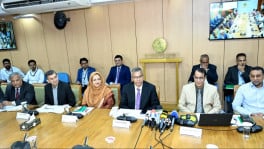
The interim government is moving to clear more than Tk20,000 crore in unpaid dues to private power producers to avert potential load-shedding this summer and avoid passing a large financial burden to the next elected government, Power and Energy Adviser Mohammad Fouzul Kabir Khan said.
"Arrangements are being made to settle the outstanding payments. Even today (Monday), a meeting was held with the finance adviser regarding the resolution of power sector arrears," he told The Business Standard.
He said the government was aiming to clear the dues swiftly so that the incoming administration does not face immediate pressure from accumulated liabilities in the power sector.
 Keep updated, follow The Business Standard's Google news channel

Industry insiders, however, warn that prolonged payment delays driven by subsidy constraints and fiscal stress are already limiting private producers' ability to import fuel, raising the risk of plant shutdowns at a time when supply margins remain thin.
The threat has become acute at SS Power I Limited, a coal-fired plant owned by the S Alam Group that supplies more than 1,100 megawatts of electricity to the national grid each day. The company has warned that it may suspend generation within days unless overdue payments are settled.
In a letter sent to the Bangladesh Power Development Board (BPDB) on 1 January, SS Power said unpaid bills had crossed Tk4,000 crore, an amount that, under its power purchase agreement, gives the company the right to halt generation if payments are not settled by 15 January.
Industry insiders say SS Power is not an isolated case. According to the Bangladesh Independent Power Producers' Association (Bippa), BPDB's outstanding liabilities to private power producers stood at around Tk20,000 crore as of November 2025.
"Prolonged payment delays could severely disrupt electricity supply during the upcoming Ramadan and the peak summer months," said a power producer, requesting anonymity. "A new government is expected to take office soon, and inherited arrears of this scale could become one of its first major economic and governance tests."
BPDB officials acknowledge that even a partial shutdown of large plants would immediately create a supply gap, particularly as many gas-based power stations are operating far below capacity due to fuel shortages.
They warn that the loss of reliable baseload generation would significantly heighten the risk of load-shedding in the coming months, as alternative sources are already stretched and system flexibility remains limited.
"If SS Power suspends generation now, there will be a shortfall of around 1,200 megawatts," said Md Jahurul Islam, a BPDB member, describing the impact as immediate and difficult to absorb.
Anjona Majlish Khan, BPDB member for finance, said she hoped SS Power would not proceed with a shutdown, pointing to earlier standoffs that were eventually resolved.
"They had issued suspension notices before. On those occasions, BPDB cleared their dues and convinced them to continue the generation," she said. "We believe the government will find a way this time as well."
On arrears owed to other private producers, Majlish Khan said payment backlogs were cyclical rather than indicative of a structural breakdown.
"Private plants submit bills; we verify them and make payments. At times dues accumulate, and at other times they fall once payments are made," she said.
Payment delays strain operations at SS Power
In a letter to the Bangladesh Power Development Board (BPDB), SS Power I Limited (SSPIL) said its unpaid bills have exceeded Tk4,000 crore, even after receiving Tk1,500 crore in December.
The company said payment delays have hampered its ability to procure coal, spare parts, and other essentials, while leaving it struggling to meet its own obligations.
SSPIL had warned that one of its units would need to shut down from 1 January 2026 but, citing public interest and grid stability, conditionally agreed to defer the closure until 15 January.
The deferment is conditional on BPDB releasing $84 million or its taka equivalent to clear contractor and supplier dues and ensure uninterrupted coal supply.
"Failing receipt of either payment within the stated timeframe, SSPIL shall have no alternative but to proceed with shutdown of at least one unit, and further units as operationally required," it said.
SS Power also stressed that the December payment did not constitute a contractual cure under the power purchase agreement and sought written assurances that any generation cuts due to non-payment would not be treated as company-caused outages or trigger penalties.
Confirming the suspension notice, SS Power CFO Ebadat Hossain said outstanding dues stood at about Tk3,200 crore until November and rose beyond Tk4,000 crore after the December bill.
"We wrote to BPDB on 10 December and again on 28 December requesting payment. After our request was declined, we issued a suspension notice on 29 December," he said.
BPDB responded the following day, asking the company to withdraw the notice and assuring it of payment, Hossain added. "Considering that request, we deferred the suspension but informed BPDB that generation may be partially or fully suspended by 15 January if payments are not cleared."
He said the plant requires 12,000–14,000 tonnes of coal daily to operate at full capacity. "Without covering our costs, it is simply not possible to keep the plant running," he said.
BPDB warns of immediate supply impact
BPDB officials conceded that a shutdown at SS Power would create an immediate supply gap, even though electricity demand remains subdued during winter.
Jahurul Islam said the board could attempt to manage demand by restarting plants currently kept idle due to low winter consumption, but cautioned that the process would take time.
"To bridge the gap, gas-based plants would need to be restarted," he said. "But gas supply remains constrained even in winter, which would require higher LNG imports."
AKM Jashim Uddin, superintendent engineer of BPDB's Chattogram East Zone, said there is currently no load-shedding as demand remains low.
"In summer, demand ranges between 15,000 and 16,000 megawatts. In winter, it falls to around 8,000 to 10,000 megawatts," he said, warning that the situation could become critical if the dispute persists into peak season.
Shrinking gas supply adds to load-shedding risk
Gas supply to power plants continues to lag far behind demand and has been declining further in recent days.
According to Petrobangla data, power plants received 700 million cubic feet per day (mmcfd) of gas on 4 January against demand of 2,525mmcfd. Supply fell to 662mmcfd on 3 January—barely a quarter of required levels.
Bangladesh has 152 power plants, both public and private, and also imports electricity from India and Nepal. BPDB data show that electricity demand on 5 January stood at 10,542 megawatts, while total generation, including imports, was 10,068 megawatts.
Although BPDB regularly publishes daily generation and load-shedding data, no load-shedding figures have been uploaded since 28 December. As of 4 January, 33 power plants were shut for maintenance.
The power adviser, however, said there was no official indication of load-shedding.
"A temporary disruption in electricity supply does not mean load-shedding," Fouzul Kabir Khan said. "Short suspensions for repair and maintenance are necessary to ensure uninterrupted supply during the summer and should not be described as load-shedding."