Mugging fears grow in Dhaka as fatalities, violent incidents rise
Though official data show a rise in reported muggings in recent months, experts claim the actual number is likely far higher, as many victims refrain from filing cases

Mugging incidents in Dhaka continue to fuel public anxiety, with several recent cases ending in death or serious injury and raising questions about the effectiveness of law enforcement measures.
Though official data show a rise in reported muggings in recent months, experts claim the actual number is likely far higher, as many victims refrain from filing cases.
The latest victim was 42-year-old Soheli Islam, a medical service officer of a pharmaceutical company, who died after being pulled down from a moving battery-run autorickshaw during a mugging attempt.
She was returning to Dhaka from her village home in Dinajpur with her daughter. According to relatives, they got off a bus at Gabtoli in the early hours of June 7 and were travelling to their home on Central Road in Dhanmondi.
 Keep updated, follow The Business Standard's Google news channel
As their autorickshaw reached in front of Shaheed Suhrawardy Medical College Hospital, two muggers riding a motorcycle allegedly grabbed and pulled Soheli's vanity bag. The force of the pull threw her onto the road from the moving vehicle, leaving her critically injured.
After four days of treatment at a hospital, she died on 11 June. A case was filed on 13 June with the Sher-e-Bangla Nagar Police Station against unidentified suspects, but no arrests have been made.
On 19 March in Uttara. Housewife Mukta Akter, 21, died after falling from an autorickshaw when muggers allegedly snatched her handbag while she was on her way to Eid shopping.
Although such deaths draw public attention, muggings occur regularly across the capital, particularly late at night and before dawn. Victims often lose cash, mobile phones and valuables, but many choose not to pursue legal action beyond filing a general diary.
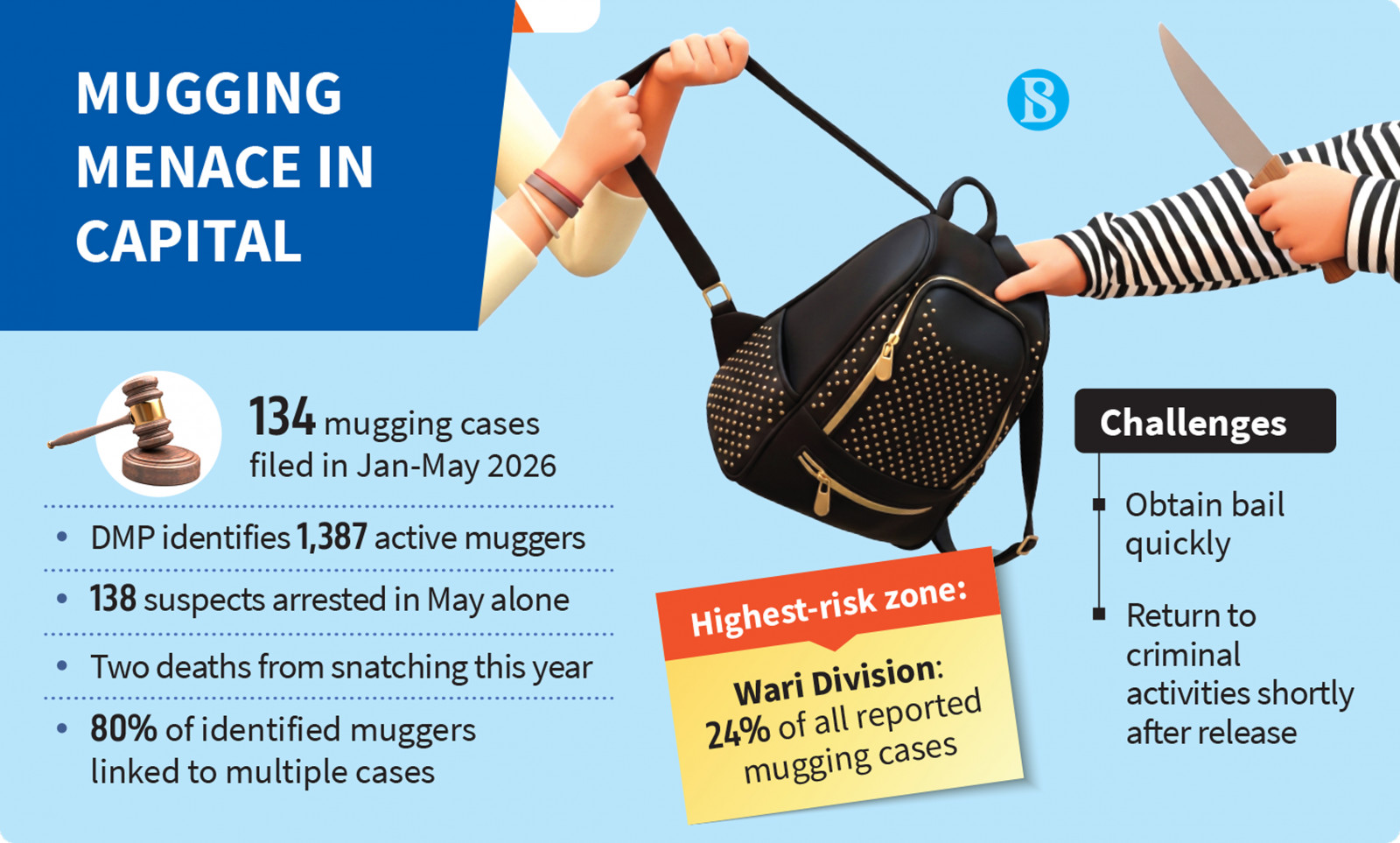
According to Dhaka Metropolitan Police data, 134 mugging cases were filed across its eight crime divisions between January and May this year. The highest number, 33 cases, was recorded in May, compared to 29 in January, 22 in February and 25 each in March and April.
Among DMP divisions, Wari recorded the highest number of mugging cases during the five months with 32, followed by Tejgaon with 24 and Motijheel with 21. Lalbagh recorded the fewest cases at four.
Nearly 1,400 active muggers
Police data show that 1,387 muggers are currently operating in the capital. Wari has the highest concentration with 308 identified offenders, while Mirpur has the lowest at 53. Authorities say around 80% of them are accused in multiple criminal cases.
Mallik Ahsan Uddin Sami, deputy commissioner of DMP's Wari Division, told TBS that parts of the Dhaka-Chattogram Highway and the Demra Expressway fall under his jurisdiction, making the area particularly vulnerable.
He said muggers often target vehicles stuck in traffic by snatching mobile phones through windows, while passengers arriving in Dhaka from outside districts during the early morning hours also become easy targets.
Sami said police arrested 138 suspected muggers in May and have intensified patrols, blockades and plainclothes operations. However, many suspects secure bail and return to criminal activities.
Firearms becoming more common
On 7 June, money exchange businessman Lokman, 45, was shot and robbed of $17,000 near Motijheel's Shapla Chattar. The attackers allegedly shot him three times before fleeing with the cash. He remains under treatment, while no arrests have been made.
Even police personnel are facing increasing risks. On 12 June, two officers were stabbed while attempting to arrest muggers in the Zia Udyan area under the Sher-e-Bangla Nagar Police Station. Police later detained two suspects, although another escaped.
Experts call for reforms
Md Tawohidul Haque, criminologist and faculty member of Dhaka University, said the gap between law enforcement measures and ground realities has made it difficult to control crimes such as theft and mugging.
He said organised criminal groups are increasingly involved in such offences, with many offenders carrying weapons and, in some cases, being under the influence of drugs. As a result, victims are often seriously injured or killed during attacks.
According to him, effective crime control will require reforms in both law enforcement and the justice system, alongside action against the organisers and patrons of criminal networks rather than only street-level offenders.
MZM Intekhab Chowdhury, spokesperson of Rapid Action Battalion, said law enforcement agencies are responding quickly to incidents and working in coordination to arrest offenders. However, he stressed that mugging and theft are not only law-and-order issues but also reflect broader social challenges, including moral decline and the pursuit of easy money through illegal means.
Muhammad Shamsuddoha Sumon, a Supreme Court lawyer and an additional public prosecutor, said police sub-inspectors often delay submitting charge sheets and also face allegations of weakening charges in exchange for unethical benefits. As a result, criminals are able to secure bail more easily.
Highlighting what he described as a decline in professional ethics among lawyers, Sumon said many lawyers also fail to uphold ethical standards. Once cases involving mugging, extortion or narcotics offences go to trial, they are no longer under the control of the police.