



Country's first ocean satellite ground station launched at Chittagong University
The project has been implemented jointly by the University of Chittagong and Second Institute of Oceanography

The country's first-ever ocean satellite ground station has been inaugurated at Chittagong University (CU) to enhance Bangladesh's capabilities in natural disaster forecasting and marine resource management.
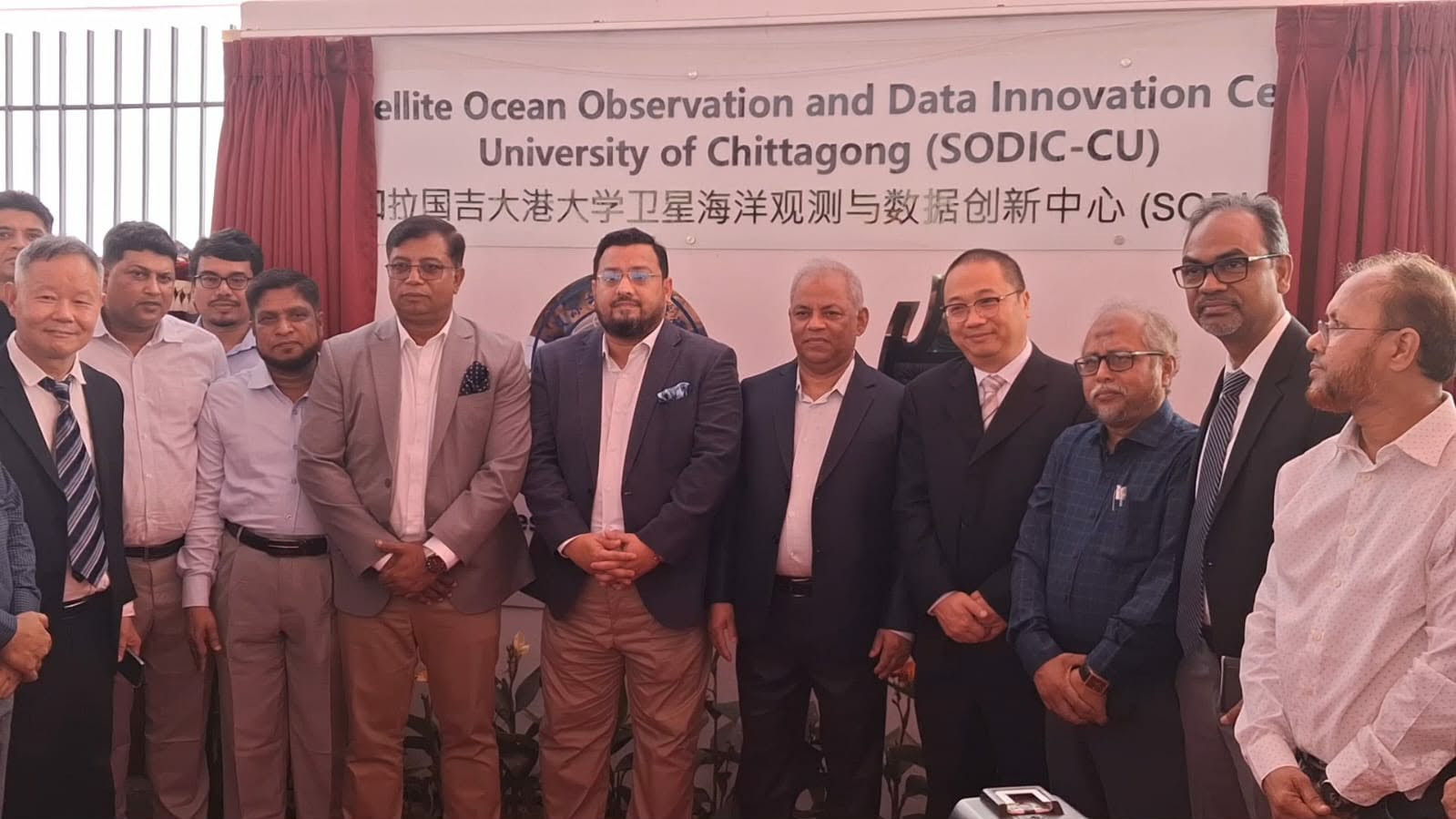
The Satellite Ocean Observation and Data Innovation Centre was officially inaugurated this morning (9 June).
The facility was unveiled by Mir Mohammad Helal Uddin, state minister for land and Chittagong Hill Tracts affairs.
 Keep updated, follow The Business Standard's Google news channel

Following the inauguration of the Ocean Satellite Ground Station in front of the Faculty of Marine Sciences in the morning, a discussion was held at the auditorium of the Faculty of Business Administration at the University of Chittagong.
The event was presided over by Vice-Chancellor Professor Dr Mohammad Al-Forkan. Land and Chittagong Hill Tracts Affairs State Minister Barrister Mir Mohammad Helal Uddin attended as the chief guest. Special guests included University Grants Commission (UGC) Chairman Professor Mamun Ahmed, UGC Member Professor Mohammad Ayyub Islam, Pro-Vice-Chancellor (Academic) Professor Mohammad Shamim Uddin Khan, Pro-Vice-Chancellor (Administration) Professor Dr Md Kamal Uddin, Cultural Counsellor of the Chinese Embassy in Bangladesh Li Shaopeng, and Deputy Director of the Second Institute of Oceanography Professor Fu Bin.
Addressing the discussion marking the official inauguration of the Satellite Ocean Observation and Data Innovation Centre, State Minister Mir Mohammad Helal Uddin said the facility would play a vital role in the collection and utilisation of ocean-related data for fisheries, weather forecasting and marine observation, particularly in the field of oceanography.
For a maritime nation like Bangladesh, he said, a deeper understanding of marine resources is essential to unlocking the vast potential of the blue economy. Improved data collection and sharing would strengthen disaster forecasting—especially for cyclones—helping reduce losses of life and property.
The state minister added that the centre would also benefit fishermen and the fisheries sector by providing timely information on sea conditions and potential fishing zones. Despite the importance of such services, Bangladesh continues to incur losses due to limited forecasting capacity, he noted. He expressed hope that the new centre at the University of Chittagong would significantly enhance preparedness and emerge as one of the country's most impactful scientific initiatives.
UGC Chairman Professor Mamun Ahmed described the Satellite Ocean Observation and Data Innovation Centre as a groundbreaking initiative with immense academic and scientific significance for Bangladesh and its economic development.
He noted that the centre's location at the University of Chittagong, near the Bay of Bengal, makes it particularly relevant for a country where the ocean is both a key economic asset and a source of natural hazards such as cyclones and storm surges. The facility, he said, would help transform ocean-related data into actionable knowledge for policymaking, early warning systems and economic activities, particularly in fisheries and coastal livelihoods.
Highlighting advances in modern technology, he said satellites now enable continuous monitoring of ocean temperature, currents and wave patterns, allowing round-the-clock data collection and analysis. The integration of data acquisition and analytical capabilities, he added, is the centre's greatest strength.
However, he stressed that the true success of the initiative would depend not on technology alone, but on the teachers, researchers and students who would drive innovation, research and practical applications.
Urging the academic community to move beyond traditional classroom boundaries, he called for research and technology to be directed towards improving people's lives. He expressed hope that the centre would not only strengthen disaster preparedness and save lives but also nurture world-class researchers whose contributions would benefit both Bangladesh and the global scientific community.
He concluded by saying that the initiative has the potential to be remembered as a milestone in Bangladesh's scientific and academic journey.
Project details
The project, costing around Tk70 crore, has been implemented jointly by the University of Chittagong and Second Institute of Oceanography. The Chinese institution has contributed approximately Tk60 crore in technical and mechanical support.
According to project officials, Bangladesh currently relies on data from foreign agencies, resulting in a 20 to 30-hour delay in receiving critical information. Once fully operational, the ground station will be able to collect and analyse detailed coastal data within just 10 to 15 minutes.
The station is capable of receiving data from multiple ocean and Earth observation satellites operating over the Bay of Bengal. Using this information, authorities will be able to analyse sea surface temperatures and cloud movements to issue cyclone and storm surge warnings 48 to 72 hours in advance.
The facility will also help identify potential fishing zones in the Bay of Bengal and support oil and gas exploration by analysing sea surface salinity and temperature.
Project officials said an SGSMRS 2035 Master Plan is being prepared to transform Bangladesh into South Asia's leading marine data hub by 2035. Plans are also underway to establish a second data centre in Cox's Bazar and integrate artificial intelligence technologies into future operations.
Construction of the station was formally launched on 26 March, 2025, at the university's Faculty of Marine Sciences. Following the inauguration, a discussion session was held at the Business Administration Faculty auditorium.


