



Gold vs Bitcoin vs Real Estate: Which is actually safe in 2026
Gold offers stability, Bitcoin brings high-risk digital growth, and real estate delivers long-term income and tangible value. This guide breaks down how each investment works so you can choose with clarity in 2026.

You have money to invest, but you feel stuck. Should you buy gold, put cash into Bitcoin, or buy a house? Each choice promises safety, yet each one carries very different risks.
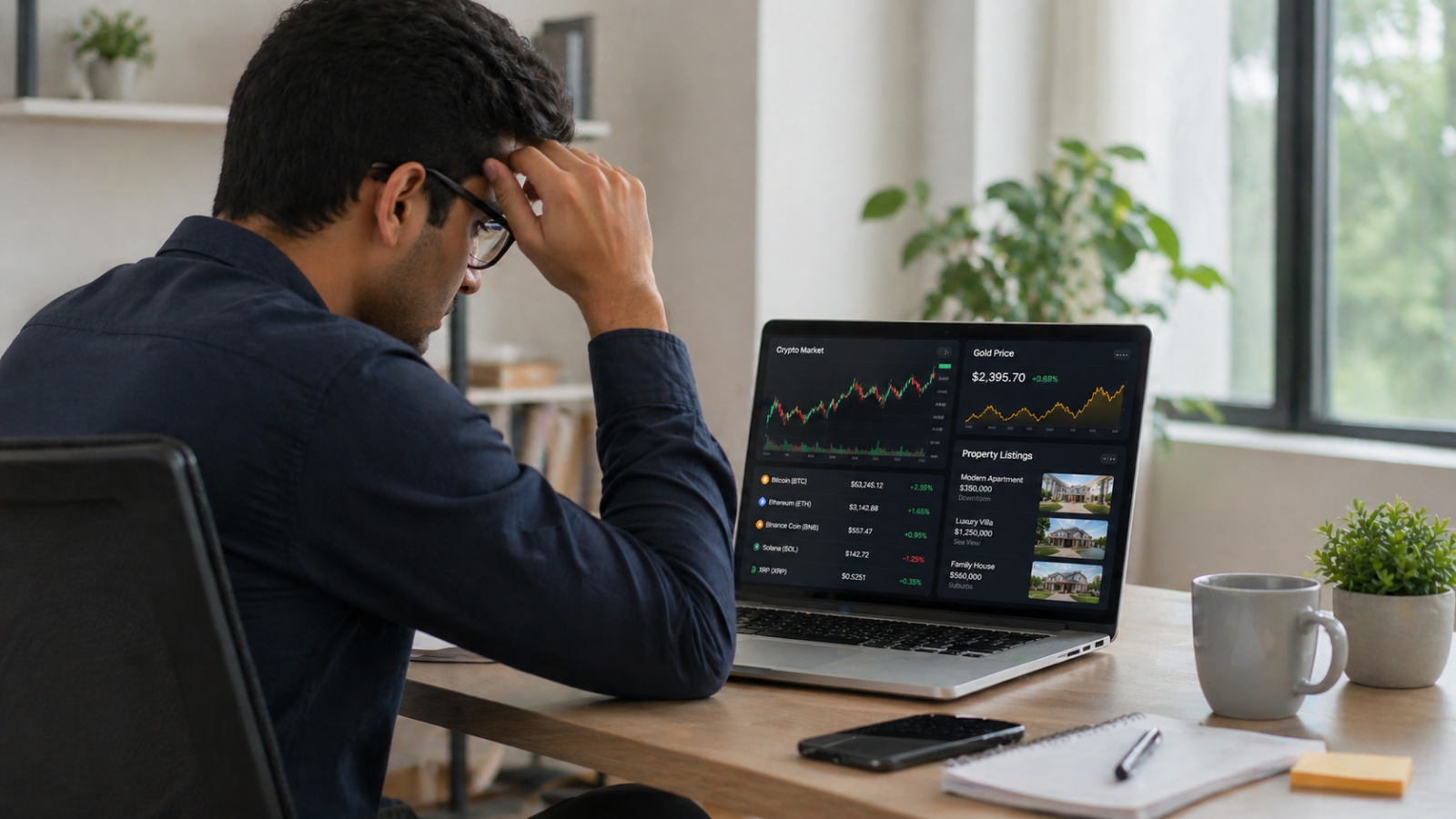
We completely understand the frustration.
You read articles that contradict each other constantly. One expert says real estate wins, another swears by cryptocurrency, and a third tells you gold never fails. This confusion costs you time and money.
Your savings sit idle while you research endlessly. A Gallup poll shows that 37% of Americans view real estate as the best long-term investment, whilst only 23% prefer gold and 16% favour stocks. This tells you something important about how people disagree on what keeps money safe.
 Keep updated, follow The Business Standard's Google news channel
We are going to walk you through the exact steps we think are the best, and we think you will be surprised at how clear it can be. We will look at how each investment works, the real risks, and the rewards.
By the end, you will have a clear picture of your options. So grab a cup of coffee, and let's go through it together.
Comparing gold, Bitcoin, and real estate as investments in 2026
Three investment paths stand before you in 2026, each with distinct characteristics and risk profiles that warrant careful examination. Gold offers stability, acting as a traditional safe haven during uncertain times. Investors have trusted it for protection against inflation and currency devaluation. Its inverse relationship with stocks means it often rises when markets fall.

Bitcoin represents the new frontier, having delivered staggering returns since 2009. Volatility remains its defining feature. Early adopters saw life-changing gains, whilst recent entrants faced significant losses. This asset class attracts risk-tolerant investors seeking explosive growth potential.
Real estate provides tangible security that neither gold nor Bitcoin can match. Gallup polling reveals that 37% of Americans favour property investments over alternatives. Rental income transforms property into an active wealth-generating machine, not merely a store of value.
-
The Institutional Shift: Wall Street now actively participates in these markets. Spot Bitcoin ETFs, like BlackRock's iShares Bitcoin Trust (IBIT), hold billions in assets. This allows you to add cryptocurrency to a traditional brokerage account without managing a technical digital wallet.
-
The Accessible Metal: In the U.S., the SPDR Gold Shares (GLD) serves as the largest physical gold ETF. You avoid the high dealer markups of physical coins by trading them just like a stock.
-
The Effort Factor: Gold demands minimal effort beyond purchase and storage. Bitcoin requires cybersecurity vigilance. Real estate involves active management, maintenance costs, and tenant relations.
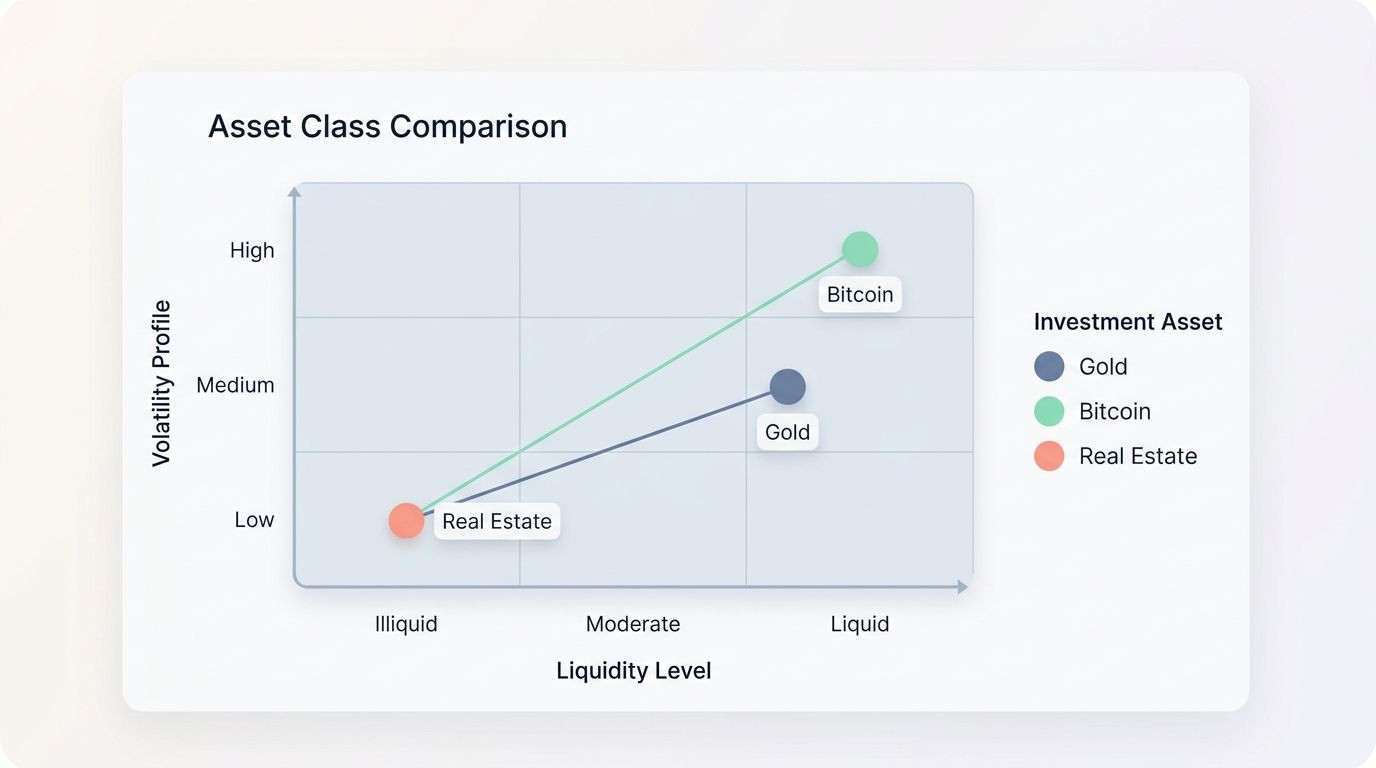
The table below breaks down how these assets stack up against one another across several critical dimensions.

|
Investment asset |
Historical performance |
Volatility profile |
Liquidity level |
Tangible nature |
Income generation |
|
Gold |
Steady appreciation over decades; acts as hedge during economic downturns; valued for centuries as store of wealth |
Low to moderate; moves inversely to stock markets; provides stability during inflation spikes |
High; easily bought and sold through dealers, ETFs, or futures markets; quick conversion to cash possible |
Fully tangible; you can hold it physically; storage and insurance required for security |
None directly; value derives from price appreciation and protective properties only |
|
Bitcoin |
Launched in 2009; exceptional growth from pennies to five figures, outpaced most assets since inception, subject to boom-bust cycles |
Extremely high; swings of 20-30% in single days common; influenced by sentiment, regulation, and tech developments |
High in theory; exchanges operate 24/7; practical liquidity varies with market conditions and order sizes |
Digital only; exists on blockchain; no physical form whatsoever; requires digital wallet and security measures |
None; gains come purely from price appreciation; staking offers some returns on newer networks |
|
Real estate |
Long-term appreciation; 37% of Americans view it as the best investment; generates rental income streams; weathered multiple market cycles |
Low to moderate; slower price movements than stocks; regional variations affect stability; less reactive to daily news |
Low; sales take months; cannot quickly convert to cash without discounting; requires buyer and favourable conditions |
Completely tangible; physical property you occupy or lease; land cannot disappear; depreciation and maintenance occur |
Strong; rental income provides monthly or annual cash flow; mortgage payments covered by tenant contributions; tax deductions available |
Gold: A traditional safe haven

Gold has protected people's wealth for thousands of years, acting as a shield against inflation and economic chaos. People turn to gold when banks fail, currencies collapse, or geopolitical instability shakes the world.
Key features of gold as an asset
Gold sits at the heart of wealth preservation. This precious metal holds value across centuries, generations, and economic cycles. Investors prize gold because it moves differently from stocks or bonds.
When markets crash, gold often climbs higher. The precious metal reached an all-time high of 4,225.10 pounds per ounce in early October, then dropped 6.3% shortly after. This price action shows gold's strength during uncertain times.
Central banks stockpile gold as collateral. Financial institutions trust gold to back their reserves. Your money in gold stays protected from currency collapse. When the US dollar weakens, gold strengthens.
-
Physical Dealers: Companies like APMEX allow you to securely purchase physical bullion online. They ship it directly to your secure storage, ensuring you hold a physical asset off the banking grid.
-
Digital Convenience: The SPDR Gold Trust (GLD) carries a low 0.40% expense ratio. This means you avoid the high markup fees of physical coins while maintaining direct exposure to gold prices.
-
Inflation Defence: Fiat currencies lose purchasing power, but gold maintains it. This inverse relationship makes gold a reliable inflation hedge.
Gold's liquidity sets it apart from real estate investments. You can sell your gold quickly without waiting months for a buyer. Real estate demands time, paperwork, and a realtor's involvement.
Gold requires just a phone call or an online transaction. The asset classes differ greatly in accessibility. After the 2008 financial crisis, gold prices rose 32.8% in 2011 alone.
Risk-averse investors flocked to this stable asset during market volatility. Capital gains tax applies to gold sales, yet many investors accept this cost for safety. Your portfolio gains a hedge against geopolitical instability when you own gold.
Pros and cons of investing in gold

Investing in physical gold offers certain protections, yet it carries real disadvantages that can reduce your returns and make your life more complicated.
|
Pros of investing in Gold |
Cons of investing in Gold |
|
Low risk profile: You hold a tangible asset that won't vanish overnight. Gold maintains its physical form, regardless of market chaos or economic turmoil. |
Hefty tax burden: Capital gains tax on physical gold reaches as high as 28% in the US. This rate sits well above the 20% levied on stocks and bonds, reducing significantly your profits. |
|
Inflation hedge: Many investors turn to gold when they fear currency devaluation. It serves as a safety net against purchasing power erosion over time. |
Minimal growth returns: Historical data shows average returns hovering around 4% annually. This modest performance may not provide adequate inflation protection when you consider rising costs. |
|
Emotional security: Owning physical gold provides psychological comfort. You can touch it, see it, and know exactly what you possess. |
Storage and insurance costs: Physical gold demands vault space or secure storage solutions. Insurance premiums add another layer of expense to your investment, reducing net returns year after year. |
|
No economic output: Unlike real estate or dividend stocks, gold generates no income stream. Yet this simplicity appeals to investors seeking straightforward asset holding. |
Administrative fees: Vault holders charge ongoing maintenance fees for safeguarding your bullion. These charges accumulate over decades, quietly reducing your wealth. |
|
Universal recognition: Precious metals carry value across cultures and borders. You can trade gold in virtually any major economy worldwide. |
Liquidity challenges: Selling physical gold proves difficult due to its weight and bulk. You will need insurance for transport, and finding reputable buyers takes time and effort. |
|
Portfolio stability: Adding gold to your investment mix reduces fluctuations. It often moves opposite to stocks, providing natural portfolio balance. |
Price volatility: Recent declines of over 5% to approximately £4,130 demonstrate gold's price swings. Markets linked to government shutdowns or geopolitical events can trigger sharp drops unexpectedly. |
|
No default risk: Gold will not disappoint you with corporate failures or company bankruptcies. The metal maintains intrinsic value independent of any organisation's performance. |
Lack of inherent worth: Gold possesses no economic value beyond what buyers will pay for it. Unlike companies or property, it generates nothing internally to justify its price. |
Bitcoin: Digital asset with high growth potential

Bitcoin operates on a decentralised network that removes middlemen from transactions, making it faster and cheaper than traditional banking systems. This digital currency has grown from a fringe experiment to a major asset class that investors worldwide now track alongside stocks, bonds, and commodities.
Key features of Bitcoin as an investment
Bitcoin operates on a deflationary model that creates genuine scarcity. The network caps supply at exactly 21 million coins, which means no central authority can print more. This fixed limit positions Bitcoin as digital gold for the modern age.
Your purchasing power stays protected because the supply never increases. Gold mines can produce more gold each year, but Bitcoin's code prevents this problem entirely. The network itself enforces this scarcity rule, making it impossible to break.
The 2024 Bitcoin Halving cut mining rewards down to 3.125 BTC per block. This programmatic reduction in new supply reinforces Bitcoin's scarcity precisely when fiat currencies face inflationary pressures.
Investors gain confidence knowing that supply constraints support long-term value preservation. Trading Bitcoin happens instantly across global exchanges, twenty-four hours a day. You can sell your holdings at any moment without waiting for markets to open. This liquidity gives you real agility when you need to access your funds.
Regulated US exchanges like Coinbase provide a secure environment for personal finance management. They offer insured custodial wallets, reducing the risk of losing your private keys. The asset proved its worth by rising from $0.00099 in 2009 to over $88,000 today.
Over the last decade, Bitcoin consistently outperformed other asset classes, delivering exponential returns despite volatility swings. Institutional interest keeps growing, with major financial organisations now holding Bitcoin on their balance sheets. Your investment portfolio gains portability too, as Bitcoin resists confiscation and avoids local economic troubles or geopolitical issues.
Pros and cons of investing in Bitcoin
Weighing up the advantages and disadvantages of digital currency investments requires a clear head and honest assessment of both the thrilling highs and stomach-churning lows.
|
Pros of investing in Bitcoin |
Cons of investing in Bitcoin |
|
Exceptional liquidity: You can convert your holdings into cash faster than selling property or gold bars. Markets operate round the clock, seven days a week. |
Extreme volatility: Prices swung from £48,000 down to £16,000 within twelve months. Such wild swings test even seasoned investors' nerves. |
|
Zero maintenance costs: You pay no storage fees, insurance premiums, or upkeep expenses. Your digital wallet sits dormant, costing nothing to maintain. |
Lacks fundamental backing: No government, company, or asset supports its value. It functions purely as a trading instrument without intrinsic worth. |
|
Decentralised ownership: You control your assets without relying on banks or financial institutions. Younger, tech-savvy investors particularly value this independence from traditional systems. |
Fraud and scam risks: Sam Bankman-Fried's FTX collapse wiped out billions in customer funds. Scams persist across exchanges, wallets, and trading platforms. |
|
Borderless transactions: Send funds across continents without currency conversion hassles or banking delays. Geographical boundaries disappear completely. |
Complex technology requirements: Understanding blockchain, private keys, and digital wallets demands technical knowledge. One mistake can mean permanent loss of your investment. |
|
High growth potential: Early adopters witnessed extraordinary returns over the past decade. Opportunities for substantial gains remain available to those willing to take risks. |
High-risk tolerance needed: Only investors comfortable losing their entire stake should participate. Market sentiment can shift overnight, destroying portfolios in hours. |
|
No physical limitations: Store unlimited amounts without warehouse space or security concerns. Your entire fortune fits on a hard drive. |
Capital gains tax obligations: Your profits face the same tax treatment as gold investments. Tax authorities view digital currency gains as taxable income. |
Real estate: Tangible asset with long-term stability

You can touch a house or a flat, which makes property investment feel real in a way that digital coins never will. Real estate builds wealth over decades through rental income, property appreciation, and the power of leveraging borrowed money to grow your assets faster.
Key features of real estate as an investment
Real estate stands out as a tangible asset that appreciates over time, producing wealth through multiple channels. Property owners gain value as markets grow, and they collect rental income from tenants each month.
The National Association of Realtors reported that homeowners gained approximately £147,000 in housing wealth over the past five years. Real estate values have appreciated at an average five-year return of plus 26% since 1975, according to Realtor.com analysis.
Unlike stocks or the Bitcoin network, an investment property sits in your hands as something physical and real. Investors can actively shape their returns through strategic upgrades, smart rental management, and property improvements.
-
Tax Advantages: Tax deductions sweeten the deal considerably, since mortgage interest and depreciation reduce your taxable income each year.
-
Market Timing: Organisations like Freddie Mac track average US mortgage rates. Checking their data helps you lock in a lower rate to save thousands in interest over the life of your loan.
-
Passive Alternatives: Real Estate Investment Trusts, or REITs, offer another route into property markets. Companies like Realty Income Corporation (O) pay monthly dividends, giving you cash flow without ever fixing a leaky toilet.
These trusts must distribute at least 90% of their income to shareholders as dividends. Public REITs typically yield around 4% annually, though this varies by sector and market conditions.
Real estate differs from gold or btc because it generates income by default through rental payments. A property in Southern California or North Carolina produces cash flow whilst you sleep. The investment strategy here involves leverage. You borrow money to purchase assets worth far more than your initial investment.
This amplifies your returns substantially. Natural disasters and market shifts do pose risks, so location matters tremendously. Home equity builds steadily as you pay down your mortgage and property values climb. This combination makes real estate the only asset class that practically guarantees gains through multiple mechanisms simultaneously.
Pros and cons of investing in real estate
Property ownership offers genuine control over your investment. You pick tenants, manage maintenance, and make all the big decisions yourself. This hands-on approach appeals to many investors who want to shape their asset's future.
The housing market has shown long-term stability, and direct ownership builds equity over time. You keep all rental income and profits from property appreciation. This tangible asset sits right in front of you, unlike Bitcoin or stock portfolios that exist only on screens.
However, property investment drains your wallet fast. High upfront costs hit hard before you even own the keys. Mortgage rates currently impact affordability for home purchases, making entry expensive. Maintenance expenses, property taxes, and insurance bills pile up relentlessly. Selling takes months or years, not days. You cannot access your cash quickly when you need it.
Key considerations for choosing between gold, Bitcoin, and real estate
Your risk tolerance, investment timeline, and cash flow needs shape which asset makes sense for your situation. Gold offers peace of mind, Bitcoin delivers volatility with growth potential, and real estate generates income while building wealth over decades.
Risk tolerance and market volatility

Bitcoin swings wildly, like a pendulum on steroids. One day you are up 20%, the next day you are down just as much. This volatility stems from Bitcoin's status as a relatively new asset class, which means fewer people understand it, and more speculation drives prices.
The collapse of Sam Bankman-Fried's FTX showed investors just how risky cryptocurrency can be. If you lose sleep over market dips, Bitcoin probably isn't for you.
Gold, by contrast, sits on the other end of the spectrum. It carries a low risk profile and moves more predictably.
When market conditions shift, experts often check the CBOE Volatility Index (VIX). This index measures stock market fear, helping you decide exactly when it is time to move cash into a safe haven like gold.
Yet even gold isn't immune to shocks. A US government shutdown and tariffs on gold imports triggered a 6.3% drop. Real estate occupies the middle ground, though it faces its own pressures from interest rate hikes and economic downturns.
The Federal Reserve's decisions ripple through property markets in ways that catch many investors off guard. Your risk tolerance shapes which investment makes sense for your situation. Someone with a high tolerance for volatility might chase Bitcoin's growth potential.
Someone more conservative prefers gold or real estate. The S&P 500 serves as another comparison point. It is more stable than Bitcoin but more volatile than gold. Consider your timeline as well. Can you afford to hold an investment for ten years, or do you need access to your money sooner?
Liquidity and accessibility of funds
Gold trades easily on global markets, and you can sell it quickly when you need cash. However, physical gold presents real challenges. Moving it around proves difficult due to its weight, and finding a buyer willing to take it off your hands takes time. Storing gold safely adds extra costs, too.
On the other hand, the BTC network operates round the clock, allowing traders to buy and sell Bitcoin 24/7 on exchanges worldwide. You can access your funds instantly, without waiting for markets to open or dealing with bank hours. This constant availability makes digital assets far more liquid than their physical counterparts.
-
The Property Delay: Ellie Mae origination reports show the average US home takes 45 days to close. You simply cannot rely on property for instant emergency funds.
-
The Equity Solution: Homeowners sitting on record-high equity can tap into home equity loans or HELOCs to access cash without selling the underlying asset.
-
The Digital Advantage: Digital assets deliver instant liquidity through the bitcoin network and lending platforms like Nexo, letting you borrow against your holdings in minutes.
Real estate tells a completely different story. Selling a property takes months, not days. Regulatory hurdles pile up, negotiations drag on, and you face countless complications before money lands in your account.
Potential for growth and income generation
Bitcoin has delivered stunning returns over the last decade, crushing other asset classes with exponential gains despite wild price swings. Real estate, however, shows steadier growth with an average five-year return of plus 26% since 1975.
Property values climb alongside inflation and government policies, meaning your investment grows as the economy shifts. Real estate stands apart because it produces actual income through rental payments. You collect monthly rent cheques while your property appreciates.
Remodeling Magazine's 2024 Cost vs Value report proves that specific upgrades, like a minor kitchen remodel, recoup about 85% of their cost. This lets you instantly force appreciation on your asset. Mortgage interest deductions and depreciation allowances slash your tax bills significantly.
Real estate investment trusts, or REITs, deliver dividend yields averaging around 4%, providing regular cash flow without the hassle of managing tenants. Bitcoin and gold sit idle by comparison. They generate nothing unless you loan them out for interest, leaving your money dormant.
Your actions shape real estate returns in ways that gold and Bitcoin simply cannot match. Upgrade a kitchen, and you boost property value instantly. Renovate bathrooms, and tenants pay higher rent. Strategic improvements transform your investment directly. Alex Nam and other property experts at New Star Realty understand this advantage. They help investors maximise returns through smart upgrades and rental management.
Diversification: Balancing gold, Bitcoin, and real estate in a portfolio
Spreading your money across gold, Bitcoin, and real estate works like planting seeds in different gardens. Gold sits steady and holds value when markets shake. Bitcoin offers growth potential but swings wildly up and down. Real estate generates income through rent and builds wealth over time.
Financial experts rank proper investment strategies in this order: property investments first, equity share market second, mutual funds third, and bank deposits fourth. You gain protection when you mix these three assets together. One crashes, another stays strong. Your portfolio survives the storm. Forbes and investment analysts stress this point constantly.

-
The Modern Allocation: Fidelity Investments' recent guidelines suggest a 1% to 5% allocation to digital assets. This lets you capture high growth potential while protecting your core retirement funds.
-
The Traditional Base: Middle-aged workers benefit from real estate income plus gold's stability to anchor their net worth.
-
The Protective Layer: Health insurance, term insurance, and pension plans deserve spots in your portfolio too, shielding you from unexpected life disasters.
Diversification cuts your risk in half, maybe more. You avoid putting all your eggs in one basket, which Forbes readers know leads to trouble. Your strategy should match your life stage and goals. Younger investors might lean toward Bitcoin's growth, accepting the bumps along the way.
Older adults often prefer property and gold over digital assets. Bank fixed deposits and mutual funds offer faster rewards for emergencies. Long-term investors who stay patient find properties, mutual funds, and direct shares excellent choices. Donald Trump and other successful investors all preach the same message: do not rely on one income source or one asset type.
Final words: Evaluating safety and growth potential in 2026
Your money needs a home, and you have three strong options on the table. Gold keeps your wealth steady and protects you when markets shake, but it does not grow fast.
Bitcoin offers thrilling returns for brave investors, yet it swings wildly and demands you understand digital money.
Real estate builds long-term wealth through property appreciation and rental income, though it ties up your cash and costs money to maintain. Pick gold if you want safety, Bitcoin if you can handle big swings, or real estate if you have patience and capital to invest.
The smartest move mixes all three into one balanced portfolio. This spreads your risk and catches gains from each investment type.

Frequently Asked Questions (FAQs) on Gold vs Bitcoin vs Real Estate
1. Which is safer in 2026: gold, Bitcoin, or property?
Gold has held its value through market downturns for centuries, and property gives you something tangible that people always need. Bitcoin remains highly volatile - it can drop 20-30% in a matter of weeks during market turbulence. If you want fewer surprises, gold and property tend to be steadier choices.
2. How does inflation affect gold, Bitcoin, and property?
When inflation rises, gold typically climbs as investors rush to safety - it performed strongly during the 2024-2025 US inflation period. Property usually keeps pace since rents rise alongside costs, whilst Bitcoin acts unpredictably and can drop sharply when markets turn nervous.
3. Can I lose all my money investing in these assets by 2026?
Losing everything with property or gold is rare unless disaster strikes - floods, theft, or counterfeit metals. With Bitcoin, one lost password or a major crash could wipe you out, and the FDIC doesn't protect cryptocurrency holdings like it does traditional bank accounts.
4. What should beginners know before choosing between gold, Bitcoin, and property?
Start small and don't put all your eggs in one basket. Gold feels simple to buy and store safely, property takes time and paperwork but offers steady returns over the years, whilst Bitcoin can swing 5% or more in a single day during volatile periods.


