When the host becomes the hurdle: US entry anomalies overshadow FIFA World Cup
For a month, the world will arrive in the US for football. Yet for many, arrival itself has become the first challenge

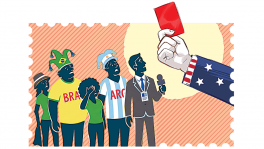
A World Cup is supposed to begin with anticipation: teams arriving, fans gathering, journalists moving from city to city, and officials preparing for football's biggest stage. But ahead of the 2026 FIFA World Cup, co-hosted by the United States, Mexico and Canada, the US has increasingly become not just a venue but a barrier.
The clearest example is Somali referee Omar Abdulkadir Artan. Named Africa's best referee in 2025, he was set to become the first Somali national to officiate at a FIFA World Cup. Instead, after arriving at Miami International Airport from Istanbul, he was denied entry by US authorities and told to return. US Customs and Border Protection said he was refused due to "vetting concerns" that made him "inadmissible".
Artan remained composed. "I thank FIFA and CAF for their support and will maintain my refereeing standards as I look ahead," he said. "I want to thank the football family for their messages and wish my colleagues all the best success during the World Cup, and I look forward to joining them again in future competitions."
 Keep updated, follow The Business Standard's Google news channel
FIFA confirmed it could not change the decision. "FIFA can confirm that match official Omar Abdulkadir Artan will be unable to train and officiate at the FIFA World Cup 2026 after he was denied entry into the United States," a spokesperson told the BBC.
Ciise Aden Abshir, a senior adviser at Somalia's Ministry of Youth and Sports, said the move damaged not only Artan but also "football's commitment to fairness, merit, and the spirit of fair play".
Artan's case is not isolated. Iraq striker Aymen Hussein was reportedly held and questioned for nearly seven hours at Chicago's O'Hare International Airport after arriving with the squad. His phone was inspected, and although he was later allowed in, the team's photographer, Talal Salah, was denied entry.
"National team photographer Talal Salah was held for more than 10 hours, underwent similar phone checks, and was ultimately denied entry into the United States," an Iraqi sporting official told the BBC.
For Iraq, returning to the World Cup for the first time in 40 years, the arrival should have been celebratory. Fans had gathered at the airport with flags, asking players for pictures. Instead, the moment became another example of how US entry procedures are overshadowing the tournament.
Iran has faced even deeper disruption. After Washington denied visas to more than a dozen delegation members, the team was forced to move its base camp from Arizona to Tijuana, Mexico. While players received visas, 14 essential support staff were reportedly refused entry. Iran's players, coaches and staff will now be allowed into the US only on matchdays, limiting their ability to train, acclimatise and prepare properly.
Coach Amir Ghalenoei criticised the treatment. "Usually in these tournaments, before technical matters, ethical and human considerations must be respected — which I think for us it was not the case," he said.
These incidents sit within a wider immigration crackdown. In June and December 2025, the US administration issued proclamations suspending entry for nationals from up to 39 countries and immigrant visa processing for 75 countries. Exemptions were made for World Cup players, coaches and essential staff, but not necessarily for fans, journalists, sponsors or extended families.
[African fans with visas] are saying there's something about this [US] atmosphere: 'I don't want to get to an airport and then have to explain myself for three hours and then somebody says, can I see your phone?
That distinction could reshape the tournament. Four qualified countries, Haiti, Iran, Ivory Coast and Senegal, fall under full or partial US travel bans. Others, including Egypt, Ghana, Jordan, Morocco, Uruguay and Uzbekistan, have faced visa delays or additional scrutiny. For many supporters, the World Cup may be geographically open but politically inaccessible.
Council on Foreign Relations immigration expert Edward Alden asked the key question, "Are people going to be scared to enter the US?"
That fear matters. A fan may have a ticket, a hotel booking and a lifelong dream, yet still worry about being questioned at an airport or asked to hand over a phone.
Council on Foreign Relations Africa expert Ebenezer Obadare said some African fans with visas are choosing Canada or Mexico instead. "They're saying there's something about this atmosphere: 'I don't want to get to an airport and then have to explain myself for three hours and then somebody says, can I see your phone?'"
For football, that absence changes the game itself. "If you don't have those people in the stands, it's not the same thing," Obadare said.
The barriers are not only political. The 2026 World Cup is expected to have some of the most expensive tickets in tournament history. At one stage, non-immigrant visa holders from Algeria, Cape Verde, Ivory Coast, Senegal and Tunisia were expected to face a $15,000 bond requirement to attend matches in the US. The requirement was later waived for fans who bought tickets by mid-April, but the episode showed how easily politics can affect fan mobility.
Journalists also face hurdles. Some have encountered visa denials, while others reportedly received single-entry visas. In a tournament spread across three countries, that could stop reporters from covering matches in Canada or Mexico and returning to the US for later rounds.
Security is, of course, a legitimate concern. The US has allocated hundreds of millions of dollars for cybersecurity, emergency response, stadium protection and counter-drone measures. Intelligence warnings have reportedly pointed to risks of extremist attacks, civil unrest and disruption of transport. ICE has also said it will play a role in World Cup security, unsettling rights groups, migrant communities and some foreign governments.
But the issue is balance. A host must protect the tournament without making participants feel unwelcome. Relations between the US, Mexico and Canada have already been strained by trade disputes, immigration debates and border policies during the second Trump administration. What was promoted as a symbol of North American cooperation now sits beside a harder political reality.
For one month, the world will arrive for football. Yet for many, arrival itself has become the first challenge. The 2026 World Cup may not only test teams on the pitch; it may also test whether a host can secure its borders without closing the spirit of the game.